February 28, 2013
June 14, 2012
Hack your competitor's campaign
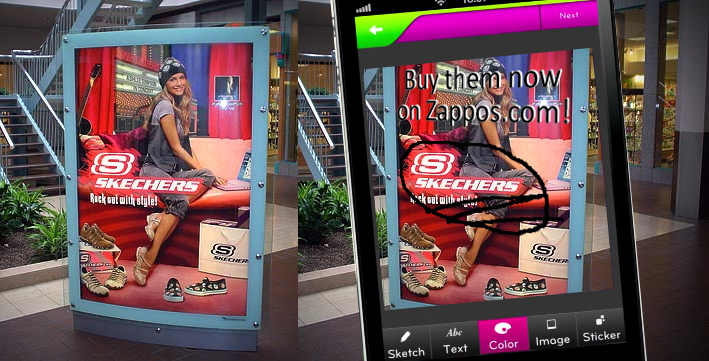
While their national soccer team isn't doing great things at the European Championship, the Dutch app and AR builder LAYAR has enhanced its augmented reality platform with STIKTU. Stiktu is a new app that enables users to -as they put it themselves- 'remix the real world'.
The idea is as simple as it is brilliant. Scan reality around you, add whatever you want to the scanned image, and post it on LAYAR's virtual reality. What STIKTU does, is giving augmented reality into the hands of the people.
Now marketing and communication wouldn't be what they are if they didn't think of creative ways to use innovations. STIKTU opens a bright new world for AMBUSH MARKETING. Where Bavaria was covered in the international press for their ambush action with pretty girls dressed in orange dresses, today every action of your competitor can be hacked, used and abused for your own profit. STIKTU gives everyone the power to change anything and to add any comment, improvement or information to anything visible in the world.
So the hunt is open. Annotate campaigns, posters and shops to express your opinion or to hack your competitors efforts.
Use the environment to promote your shop - no media fee needed.
Hack your competitor's campaign and use his efforts.
Promote your shop or webshop.
September 28, 2011
Find the 7 differences...
Railways have the same products, services and now the same ads...
Railways Belgium: "Let's build the train of tomorrow" (slogan)
Railways France: "constructing tomorrows network" (Voice Over)
August 17, 2011
Heavy Social Media Users: Weak ROI
Forbes, leading source for business news and financial information, published an interesting article on the value of High Social Media Users. And the result of their research might not show what most of us want to see...First, let's take a look at their definition of social media usage and what they consider social media:
Usage:
1. Heavy Users: People who spend 26% of their online time using social media.
2. Medium : People who spend 4.1% of their online time using social media.
3. Light : People who spend 0.42% of their online time using social media.
Social media:
Foursquare, Facebook, Twitter, blogs, etc.
Let's admit it: sounds very fair. But hey, what would you expect?
Forbes related the social media usage to the online spent in number of online buyers as well as in purchase value:
Some bloggers, even at SocialMediaToday, seem to need an explanation for this. But it wouldn't bring us any further than a hypothesis. Point is that light social media users seem to be more interesting for your online commerce.
Meaning that today's marketer has again a new dilemma: heavy social media users are easy to reach but have a lower ROI. Light social media users (in this case People who spend 0.42% of their online time using social media) are more difficult to reach but have a higher online spent.
Damn. Social media aren't the magic solution either...
;-)
July 14, 2011
Modern traveling according to Google Maps
During the summer period, lighthearted posts can occur on this blog...
Just go from 'Taiwan' to 'China' and read line 23.
July 12, 2011
December 19, 2010
The Brand Bull
I've had an interesting experience yesterday. I was invited for an interview on big companies' customer centricity (or rather the lack of it) by Radio1, the national quali radio station in Belgium. They had created a charter and companies were invited to the studio to sign it. You can imagine that all major companies from the energy and telecom markets were present to show their good will.
As I was at the end of the program, I was waiting outside the studio and was privileged to follow the official on air version as well as the 'backstage' comments.
One of the major energy providers had sent their spokeswoman. A very confident and mediatrained apparition that was sent out on her mission to reassure the world that the company she represented was already customer aware today and will be even more customer centric in the future. As a proud protector of her employer she declared that the average waiting time before their call center picked up the phone was 28 seconds. Which was a great average, but it directly reminded me of the story of the man who drowned in the river with an average water level of 20cm. While she was pronouncing her words in front of the microphone her (I suppose) assistant made a small victory dance outside the studio. Suddenly it became clear to me that for them the whole show wasn't about customers but about free publicity on national radio. It had nothing to do with an intention to change their attitude towards the customer. The host of the program immediately interpellated the spokeswomen on the impossible to understand invoices. The selfconfident spokeswoman had no clear answer. End of the interview.
Coming out of the studio, the assistant was clearly in a victorious flush. "You did great! And on the 28 seconds they had no reply! She (the host) immediately started about the invoices. That was low", she almost shouted.
In front of me were 2 brand bulls. Responsible for the official company declarations that their bosses didn't want to pronounce or didn't want to spend time on. The initiative of Radio1 was just anioher competition for them against the other providers. Their point of view had nothing to do with customers or customer centricity. It was once again an attack on 'the others' like a dumb bull running towards the red rag And at the same time a missed opportunity to get fundamental input and insights on their customers. Another missed opportunity to show interaction with the customer. Another missed opportunity to tell their story or to start conversating with their customer. I'll suggest to Peeters and Pical, the hosts of the show, to hang the red rag outside their studio so next time the brand bulls will stay out of the studio...
Dear customer, we still have a very long way to go...
November 30, 2010
Frankly, Forget Customer Centricity
I’m getting tired of ‘Customer Centricity’. Since markete(e)rs have panicked over the empowered consumer, Customer Centricity is ‘it’. One of the basic ways to start being customer centric, is interacting with your customer. We’re all transforming into conversationalists and storytellers, or at least we should be. However, the thing is that any good conversation starts over a cup of coffee or tea. Meaning that you create a ‘moment’, you make and take time for it and you focus on each other. But when is the last time you did that as a markete(e)r before engaging the conversation with your customer? Right. Because now we’re telling stories everything will be OK?
Last week I received a message from my fellow-author Steven Van Belleghem (The Conversation Manager) asking how companies can start a conversation if they know so little about their customers. A question I also asked through Twitter some time ago. Yep, the conversation sure is a great thing, but we forget to create our coffee-break with our customers. Sorry, no time, no can do?!
8(0)-delivery-gap
Research has shown and confirmed recently (Bain & company) that 80% percent of companies (400 researched worldwide) are convinced that they deliver a superior customer experience. But only 8% of the customers agree with that. Meaning that 92% of the customers are passive loyalists; they stick to your offer because they just got used to it. Because they don’t ask questions (anymore). because they know or presume that elsewhere they’ll get the same (non-)experience. Nothing to worry, unless you’re in a market where the customer feels he gets a pretty lousy deal. And then brands like Virgin pick in. Or O2. Or Zappos. Because Zappos ‘lives’ its customer. And the company lives it values. How many companies that you know have ‘fun and weird’ as one of their major values? How many companies do you know where the financial department keeps an internal parade EVERY FRIDAY, celebrating one of their fellow colleagues?
WHY, tell me WHY!
What seems to be the problem? Why can’t we deliver customer experience? What makes it so hard? Because it is an intangible asset. Because it is difficult and complex to measure.
But consumers don’t ‘measure’ or analyze customer experience. They just live it. No discussion, no argumentation, no thick report to explain and understand. According to Bain’s report most companies don’t grasp it. Do they think that they can still decide for the customer what is a good experience and what is not? They probably still think it isn’t up to the customer himself to decide.
Forget the customer?
Certainly not unless you are suicidal and want to forget your business. But customer centricity just seems to be too high. We, market(e)rs, just can’t grasp it. We can’t work with it. And yes, we try. We try really hard. So what now?
Very simple: make it tangible. Make customer centricity tangible for the market(e)r. Don’t tell stories. We have to create a book of fairy tales or a book full of adventures. With images and heroes. And market(e)rs will start telling stories. But they need that book. Because books and iPads are tangible, stories not. Give markete(e)rs a cozy corner with a coffee machine and some choices of sweet tea. And they’ll sit down, take time and enjoy the moment. Then they’ll engage in a conversation. They’ll even start listening. And chatting. And telling things you never knew but always wanted to know.
So, what is that book in marketish?
You could call it product-service. A service that is created around a product. An example: think about your car. What makes your relationship with that brand? Whatever brand it is. “The product” would be the first answer. But since decades there are no bad cars anymore. They’re all great and drive just fine. And they’re all customer-centric in more or less the same way. As well as they’re not customer-centric in the same way. The customer focus doesn’t come from the product. It comes from the services that are created around it. The product-services. Those services that are created around a product in order to support it.
Successful product-services are very tangible AND they are customer-centric by definition. They support your products and brands, create loyalty if they’re well designed and can be all-present. If they’re not customer centric, they won’t be used. This means that you can instantly track and measure your customer focus. Product-services are customer focus made tangible.
So, forget customer centricity and customer focus. You won’t make it through that path. Embrace those services that support your product. It doesn’t matter whether they are online or offline, digital or IRL.
What matters is that they bridge your 8(0)-delivery-gap.
November 4, 2010
Deal with the Devil? GAP & Facebook ctd.
Since yesterday, Google has launched a couple of new features such as single sign-on (yeahaa), location APIs to enhance Facebook Places for theird-party apps and the possibility to offer local deals with that same Facebook Places. These local deals mean that you can check in on Facebook, go to the places app and find out what the local deals are near you.
GAP is one of the first brands to start using this: the first 10.000 customers to check in, get a free jeans. Meaning that the brand is making things up with the online community through 'free'. And those who are too late still get 40% off. Is GAP buying back its customers' sympathy this way?
Unhappy Facefans are already posting their frustration again: you do need an iPhone or an Android. Too bad for the Blackberries... (Me Android ;-) But most Facefans are very enthusiastic.
I wonder wether the jeans have the old or the new logo ;-)
October 29, 2010
The renewed marketing jive: "customer"
"You got to be kidding" was my first idea this morning. Belgacom, Belgium's biggest telecom provider (the ex-monopolist) is said to 'bow for the customer'. A big leap, I would say, as they leapfrog from 'customer disinterest' to 'customer curtsy' (Belgacom IS a lady), skipping the phase of customer centricity.
However, big disappointment, as Belgacom in their press contacts -or the media in their sensation craving- have created a headline that has nothing to do with customer thinking whatsoever: the big idea is to 'improve' the quality of complaint management. Meaning that the telephonic helpdesk will be 'open' till 10 PM 7/7 and if the technician needs to come by, you don't need to take the day off, as they will be working during the evenings also.
Big misunderstanding.
This is an example of what I call 'termabuse'. Using 'customer oriented' as descriptor for these changes is the same as laughing your customers into the face. Customers that are customer centric DO NOT have massive complaints. Managing complaints is one thing, but putting it under the umbrella of customer thinking is several bridges too far. To be clear: there is always something ready to go wrong in your product, service, delivery or use. Nothing's perfect. And that is OK. But customer centric brands get credits from their customer when things go wrong. Because they can go wrong and they have noticed that when they do go wrong, the brand is helpfull and stays customer centric. Non-customer-centric brands or companies are not helpfull. Not before and not after the moment things go wrong.
Customer centricity is adapting your system to reduce complaints, not changing your system to cope with the increasing amount of complaints.
Big stress.
That will be the result. Big stress. For the 'agents' manning the Belgacom call center. They will have to work longer, work harder and work more days. Complaints will be more fierce and more frequent; Belgacom just gave the customers the permission to be unhappy and to complain. They've just admitted that things are going wrong and that the only thing they will do about it is foresee more resources to handle the complaints.
1 minute.
The same day that Belgacom announced their 'fundamental' changes, my colleague received a letter from another 'ex-'monopolist Electrabel. The letter stated that Electrabel wants to be more customer centric. Therefore they have improved their ... yes: call-center. All calls will be handled within 1 minute. Poor call center agents. Because call centers are evaluated on the time they need to handle your problem, not necessarily on the quality of the solution they provide.
But finally, what are you interested in? To have a good product and service to start with. To have a brand that offers relevance and gives you recognition as a customer. And if things would happen to go wrong, you 'just' want a decent solution. Not more people to handle the complaint but more people to create relevance in the first place.
That would be a good start for customer centricity...
October 26, 2010
Jump the technology evolution
People in general and marketers in specific tend to think that 'evolution' is a progressive process without jumps.
True.
But that doesn't mean that nature never jumps forward and neither does marketing and business. As soon as you introduce an advanced element that fits an environment that was closed before, you can create a jump forward.
Compare it to Australia that meandered through its existence untill some fools introduced rabbits.
Anyway, the BRIC-countries can be considered as former 'closed' markets by their political system or their economic arrears. However, the techno-economic parity that we're living in today, grants full access to these areas to techno-jump over the 'western' heads.
SPICE MOBILITY is one of these techno-jumpers. This Indian telecom-player states on their site: "With "Innovation" as the company’s mantra, Spice began the process of revolutionizing the Communication & Entertainment sector, with its new age technologically advanced state of the art mobile phones."
Not only are they speaking of a 'mantra', putting their brand's spiritual dimension (cf. 4-D Branding) way ahead of the old approach, they're also actually doing it. Spice recently introduced the first 3D cell phone without 3D specs: "M-67 3D is bestowed with Auto-stereoscopic Display, which facilitate users to view three-dimensional images, enabling objects to appear more real & physical. The dedicated 3D shortcut key on the phone key lets users to switch amid 2D and 3D mode instantly. Further, the phone supports parallel version of 3D Image and Video format for that perfect viewing." And all that for under $100.
Wow.
Or what about the multi-SIM M-4580 that has enough battery to stay stand-by for 25 days. In short, while Europe is still fancying androïd apps and games (over 100.000 androïd apps since yesterday), India is winning the race. Best proof: Spice foresees 8 A&M's in the upcoming period...
I want more Spice in our market...
October 18, 2010
The GAP Story: 7 days to quickly forget.
DAY 0
October 4, 2010
GAP introduces its new logo on its site. No fuss, no fanfare, no event, just done.
Down With Design Blog reports the new logo is no good: “I really can’t understand the thinking behind this move.” In no time designers express their discontent on the bad design. Some even offer GAP a free redesign of their logo.
October 6, 2010
Kitsune Noir Blog reports: “There was a lot of brand equity in that big blue square and they didn’t move far away enough from the source for this logo to even begin to feel new or exciting.” Twitter explodes and someone (is it GAP?) starts a Twitter to defend the change: http://twitter.com/GapLogo. Gap gets a ro and contra Twitter. The internet community starts talking about Gapocalypse.
October 7, 2010
The logo gets the official name of ‘monstrosity’. GAP states/pretends the new logo is just a way to create buzz for their crowdsourcing project to find a new logo. Their Facebook page says:
“We know this logo created a lot of buzz and we’re thrilled to see passionate debates unfolding! So much so we’re asking you to share your designs. We love our version, but we’d like to... see other ideas. Stay tuned for details in the next few days on this crowd sourcing project.”
GAP is crowdsourcing for a new logo? No way. It’s just a bad PR recovery attempt the online community reacts. Since they want the world to create their new logo, where is the design brief?
Only the Time-NewsFeed seems to like the new logo. “NewsFeed personally does not mind Helvetica, and so this new logo brings to mind visions of a streamlined, technologically dominant future America where everyone wears white suits and cool glasses. Sure, it's generic, but don't you know that in the future everything looks alike?"
October 8, 2010
It takes GAP 2 days to react. Marka Hansen, President of GAP North America reacts in a column in the Huffington Post.
She states: “Our brand and our clothes are changing and rethinking our logo is part of aligning with that. We want our customers to take notice of Gap and see what it stands for today. We chose this design as it's more contemporary and current. It honors our heritage through the blue box while still taking it forward.”
She invites everyone to go into the dialogue and through their Facebook page people can send new proposals. How can she be defending a bad logo and at the same time invite people to make other proposals? One of the reactions says: “it (the logo) looks like something from a corporate powerpoint presentation”.
October 11, 2010
The GAP Facebook page end the story:
“Ok. We’ve heard loud and clear that you don’t like the new logo. We’ve learned a lot from the feedback. We only want what’s best for the brand and our customers. So instead of crowd sourcing, we’re bringing back the Blue Box tonight. “
Bye bye new logo, bye bye crowdsourcing, helo old logo.
Marka Hansen’s full statement:
"Since we rolled out an updated version of our logo last week on our website, we’ve seen an outpouring of comments from customers and the online community in support of the iconic blue box logo.
Last week, we moved to address the feedback and began exploring how we could tap into all of the passion. Ultimately, we’ve learned just how much energy there is around our brand. All roads were leading us back to the blue box, so we’ve made the decision not to use the new logo on gap.com any further.
At Gap brand, our customers have always come first. We’ve been listening to and watching all of the comments this past week. We heard them say over and over again they are passionate about our blue box logo, and they want it back. So we’ve made the decision to do just that – we will bring it back across all channels.
In the meantime, the website will go back to our iconic blue box logo and, for Holiday, we’ll turn our blue box red for our seasonal campaign.
We’ve learned a lot in this process. And we are clear that we did not go about this in the right way. We recognize that we missed the opportunity to engage with the online community. This wasn’t the right project at the right time for crowd sourcing.
There may be a time to evolve our logo, but if and when that time comes, we’ll handle it in a different way."
Hell yea... I hope so.
DAY 7 - the new logo on the site is the old one.
PS: For the occasion the blog is posted in Helvetica ;-)
September 21, 2010
Is it customer love?
Brands are often referred to as a person. They have an identity, values, a specific style, a certain character and specialists tell us that ‘a brand is like a friend’. So we have brand relationships with love brands or even lovemarks. Marketers must create loyalty through conversation with the customer and consumer and not the brand as such nor its manager but the social surrounding decides on what reputation your brand has.
Now, personification is a damn good trick in brand management as people have learned through evolution to think in examples and very concrete ideas. Meaning that abstract ideas are too hard to understand and even if we understand them, it still remains difficult to actually do something with these abstract ideas. So indeed, it is a good thing to see brands as a person and create brand relationships.
Going further into that thought, it might be interesting to see what actually helps to create a so-called love relationship between people and brands. (Knowing that I’ve never seen a customer weep because his brand was delisted or completely disappeared from the world - but let’s play this ‘brand love’ game.) Love is created through 3 simple methods.
1. Frequency
The more frequent you meet a person, the more loyal you will be to that person. That is the reason why so many (extramarital) relationships start at work: at a certain point you see them more than your own wife or husband and show more loyalty to your colleagues than to your official relationship.
Brands need to create frequency in contact. Just don’t forget to make it a relevant contact.
2. Recognition
That’s why recognition is also important. Sure, you’ll find examples of relationships where there is no recognition from one of the persons involved, but I’m talking about healthy, non-psychopathic relationships. Recognition means that you show that you understand the world of your customer/partner and its attending issues. Relevance is one good way to make sure that you create recognition, but there are other possibilities.
Brands must learn to show recognition to their customers without denying their own characteristic property.
3. Extremes
This might be completely new to marketers, but research has shown that there is a simple way to create a ‘crush’. (And as we all know, being in love is a great start towards real love.) Put 2 people together and let them experience extreme situations together -with a happy ending of course- and chances are high(er) that they will have a crush on each other. Danger is an Aphrodisiac.
Now this is a more difficult one: brands must dare to create more extreme situations with their customers.
Seen the period of brand courage implosion, I wonder whether brands are up to this…
June 15, 2010
The Pink Elephant of Soccer
The World Cup kicked off last week. Time for researchers to come up with tips and tricks to improve your favorite team’s score. One of the essential elements in World Cups are the penalties. The ball is placed 11 meters from the goal and the opponent tries to ‘fool’ the keeper in a medieval duel style. You might think that a bog hole of 7,32 by 2,44 meters should be big enough not to miss, but that is wrong. Regardless of the keeper, topscorers still manage to shoot wide and make the goalie unemployed.
How come?
For the same reason as the pink elephant in innovation processes. The pink elephant in innovation is the symbol of all the negative concept approaches. An example: if SlimFast launches an new product by telling that ‘this is not a diet’, the innovation will fail. Because the message mentioned the ‘bad word’ of diet.
The easiest way to demonstrate the strength of words planted in our minds is the pink elephant. Tell anyone ‘not to think of a pink elephant’ and they will think of one. By expressing the words, the damage is already being done. The same goes for penalties.
There are 2 main reasons why even topscorers miss penalties.
1. Stress: Research has shown that the team that is winning is the penalties scores 92% of the penalties. They’re already winning so the stress is less. The losing team only scores 60% of the penalties; the stress caused by the urge to make up arrears makes them miss far more. Furthermore, the score rate decreases as the number of penalties to take decreases. Almost 87% of the players score the first penalty, 82% score the second and only 79% the third. If you miss the first penalty, there’s still room to catch up. IF you miss the third, the damage is more difficult to recover thus the stress increases...
2. Pink elephant: Even topscorers that are coached by mentioning the things not to focus on (don’t aim the keeper, don’t miss, don’t shoot wide...) don’t only take more time to take shoot but also have a lower hit rate than positively coached players (chose your angle, hit it hard...).
Add the annoying effect of the vuvuzelas in the South African World Cup and you have all reasons to avoid penalties. Euhm, all reasons 'to win in 90 minutes'. Let’s stay positive even when our mind is playing with us!
Research: University of Exeter, University of Amsterdam, Norwegian School of Sport Sciences
May 20, 2010
Admit it: you don't know what your customer wants!
But apparently most CEO's know it. At least, according to the IBM study I mentioned in my previous post. WHen asked for ther prediction of what customers want, 82% of them think they want organizations to better understand their needs to large/very large extent. This morning I had a meeting for a European project of a global and to my surprise they suddenly admitted that untill today they had always been very confident about their customer knowledge. That is, they had always been so condifent that they've always known what customers want without ever asking them or doing whatever piece of research. Untill today.
It's a small figure in the report but a huge mental step for brands and companies. Because indeed, most companies have lost their connection woth their customers and see them as an object in stead of a subject with a changing opinion, changing moods and changing needs. Untill the relevance and meaning crisis hit them.
So, if you think you know you know your customer, ask yourself the question what the 'deal' is that your brand makes with your customer. If you don't have an immediate answer, you're in trouble; your give-and-take dynamics between your offer and the customer aren't clear. Chances are high that your offer doesn't have too much meaning for your target. Time to learn about your customer...
May 19, 2010
Customer-Company gap global phenomenon.
Only big names such as IBM are able to seduce by around 1.500 CEO's from big companies on a global level for a face-to-face interview. The advantage of this CEO profile is that not only do they have a pretty good view on their business but they also have a vision of what the future will bring. (Although this isn't a guarantee that will react accordingly.)
The results of the 2010 IBM Global CEO Study, called 'Capitalizing on Complexity' are just out and some graphs caught my attention. (I must admit that some kind of pitying feeling comes over me when I start reading this kind of reports, put I acknowledge that the times, they are changing.)
The first one is about the top priorities for companies for the next 5 years.
Number 1 priority by far is 'GETTING CLOSER TO THE CUSTOMER'. - 88%
88% of the global CEO's state that this will be their priority for the near future. As marketer and as consumer I hope they will keep that promise. I hope they will come out of their offices, get away from behind their one-way screens in research labs and start collecting true and usefull insights that are based on true (unmet) needs and aspirations. For the record, of those companies that stand out, the percentage of CEO's that esteem this as their top priority increases to 95%.
Their second priority is 'PEOPLE SKILLS'. - 81%
I rejoice at the finding that companies, after years of getting more efficient and more lean, have discovered the importance of not only their own people but also of the skills these people have. Not only because of the obvious conclusion that people without skills are a pain the ass of any company, but because skilled people are the kind of people that have more chances to get involved, to get the recognition the need and thus the kind of people that can find motivation from within theirselves, what they are doing and how they are doing it.
Third most important priority is 'INSIGHT AND INTELLIGENCE'. - 76%
Closely related to the two other priorities, 3/4 global CEO's implicitely admit that their insights and intelligence show a certain lag in solidity or at least isn't up-to-date. Companies, big and small, have difficulties keeping up the pace with the consumer's social evolution (although we and they are all consumers). Segmentations dilute, behavior becomes unpredictable and irrationality destabilizes most of the existing models. Time to regain true insights and build intelligence that can lead to clear, succesfull and applicable strategies.
All this makes me very optimistic for the future. From our own experience as consultants at Ziff-Jones, we also came to the conclusion that contrary to general expectations that smaller companies are more flexible, more outward oriented and closer to the consumer's reality, it are the big companies that are the first not only to draw lessons from the changes we live on a worldwide scale but also to draw the right conclusions.
The biggest challenge for all of us will be to act and react accordingly and to keep an open mind that is ready to capture true changes without prejudice and without 'we know it all' arrogance. Anyway, IBM's report title 'Capitalizing on Complexity' couldn't be more right today! Apple loses this one...
If you're interested in the full IBM report, you can find it here.
May 3, 2010
Uw business is 'lean' - en uw land?
België is ontstaan als buffer tussen enkele eeuwig twistende grootmachten zoals Frankrijk en Duitsland. België is daardoor een mengelmoes van culturen en ideeën op het kruispunt van Europa. Historisch gezien toch. Sommige internationale bedrijven rekenen België dan ook terecht eerder bij hun Southern Europa afdeling dan bij het noorden van Europa zoals Nederland, Duitsland en Scandinavië. Feit is dat België een land is dat rijk is aan diversiteit. Niet toevallig gebruiken enkele belangrijke multinationals zoals Coca Cola, Zara, Women'Secret en Springfield het Belgenland dan ook als testmarkt. Als een product het haalt in onze diversiteit, dan heeft het alles om het elders ook te kunnen maken.
Maar midden op een kruispunt je huisje neerpoten, heeft ook een aantal nadelen. De complexiteit van het Belgische staatsbestel is helaas immens. Met regio's, gewesten, taalgemeenschappen enzovoorts -bovenop de klassieke provincies en gemeenten- met elk hun (gedeeltelijke) verantwoordelijkheid zorgt voor een dermatig kluwen dat doodgestudeerde specialisten in grondwettelijke aangelegenheden wekelijks ter hulp moeten komen om uit te klaren wat er nu correct is en wat niet. (Ongeacht of België in een periode zit met of zonder regering.) Die complexiteit zorgt er ook voor dat het bestuurorgaan van het land tot de meest indrukwekkende van de wereld behoort. Ongeveer 1 op de 5 Belgen werkt voor een overheidsorgaan, aldus het Planbureau. Volgens een andere bron, de werkgerversdenktank VKW Metena, zouden 1.400.000 Belgen rechtstreeks of onrechtstreeks werkzaam zijn voor de overheid; daarbij worden zogenaamde pseudo-overheidsdiensten zoals NMBS (spoorwegen) of De Post meegerekend.. Dat komt grofweg neer op maar liefst 43% van de actieve bevolking.
Bedrijfsmatig beschouwd vormt de overheid van een maatschappij de overhead van die maatschappij. Kortom, een overheid is de 'vaste kost' van een land die noodzakelijk is om de boel draaiend te houden. Nog maar weinig mensen, laat staan politici, bekijken de overheid op die manier, maar het klopt volledig. Welnu, gezien de onmetelijk complexe structuur van België en de daaraan gekoppelde reeks aan overheden, groot en klein, zorgen er voor dat het land van friet en bier een van de grootste overheidkosten ter wereld heeft. Tot die conclusie kwam Petercam toen ze de Human Development Index van de OESO analyseerde. Die bekijkt 53 criteria zoals demografie, gezondheidszorg, armoede en productiviteit om te komen tot een score qua levenskwaliteit. Een Belg is volgens die analyse iemand die weinig terugkrijgt in verhouding tot de investering in overhead-overheidskost. Maar liefst 44,3% van het bbp gaat naar overheidswerking. U kan dat vergelijken met een bedrijf waar bijna de helft van de financiën verdwijnt in overhead. Dat het bovendien nog altijd officieel crisis is, zou daarbij een effect moet hebben: zoals eerder al beschreven zien veel bedrijven hun heil in de lean methode waarbij optimale efficiëntie nagestreefd wordt en de kans op variatiefouten en afwijkingen tot een recordminimum beperkt wordt. Overheden reageren niet zo rationeel in tijden van crisis. De kans dat investeringen in infrastructuurwerken gehalveerd worden, is vele malen groter dan de kans dat de administratie van openbare werken gehalveerd wordt of dat de efficiëntie van de dienst verdubbeld wordt. Ter vergelijking: Zwitserland spendeert ongeveer 1/3 van haar bbp aan haar overheden. Nochtans is Zwitserland eveneens een land met veel culturen en talen, maar niet alleen hun uurwerken blijken efficiënt.
Aangezien de Belgen binnenkort toch voor de zoveelste verkiezing staan, is de tijd misschien rijp om een Lean Minister aan te stellen?!
April 23, 2010
Hoe 'Lean' is uw business?
Lean is in. Nog meer sinds de crisis. De Lean Method is net als Six Sigma afkomstig van Toyota die een productiesysteem hebben waar ieder groot productiebedrijf in de wereld jaloers op zou zijn. Nogal wiedes aangezien Six Sigma zoveel wil zeggen als een bijna perfect proces; elke variatie in het proces wordt geëlimineerd zodat er nog slechts 4,4 fouten per 1.000.000 mogelijkheden zijn (6 sigma). Dat wil zeggen perfect tot op 99,99966%. Overal in de wereld zijn bedrijven op zoek naar Lean Directors om hun processen te verbeteren.
Lean grijpt in op 3 vlakken:
- de vraag: is er een onterechte vraagvariatie
- het proces : is er onnodige variatie in de productie bijvoorbeeld, zoals onnodig verschillende maten
- de 'waste' : waar worden dingen verspild die geen extra waarde toevoegen voor de klant
Verspillingen kunnen defecten zijn, overproductie, overcapaciteit, transport, wachttijden, op- en overslag, bewegingen, verpaatsingen, overactiviteit, en overcreativiteit.
Door de Lean Methode door te voeren worden zowel de kwaliteit verhoogd als de prijs scherp gesteld.
Maar vanzelfsprekend heeft Lean net zoals alles anders ook nadelen. Een eerste nadeel is dat Lean zich uitsluitend op de bestaande processen richt. Daardoor is er weinig ruimte over voor innovatie en vernieuwing, twee aspecten die in een beginfase vaak enige vorm van 'verspilling' nodig hebben.
Een tweede aspect dat daar sterk aan gekoppeld is, omhelst het onderdrukken van creativiteit. Creatiteit vereist namelijk ruimte en trial & error. Het vereist investeringen waarvan het resultaat onzeker is. Het vereist 'patient money' waarbij geld uitgegeven moet worden dat niet onmiddellijk opbrengt.
Het vreemde is dat ik geen bedrijf ken dat in staat is om beide essentiële aspecten te combineren: enerzijds Lean -laat ons zeggen 'doorgedreven efficiëntie- maar tegelijkertijd ook voldoende ruimte laten voor vernieuwing en creativiteit. Bovendien is de vraag of de Lean aanpak op lange termijn haalbaar is. Efficiëntie is nu eenmaal weinig natuurlijk. Correctie; efficiëntie komt zeer veel voor in de natuur maar geen enkel organisme is 'close to perfection' zoals Six Sigma nastreeft. Er is telkens opnieuw een essentiële vorm van verspilling. Maar die verspilling is niet noodzakelijk onzinnig.
Bij 3M bijvoorbeeld wordt creativiteit hoog in het vaandel gedragen. Intern wordt 'patient money' als een fundamenteel principe aanzien net als de '15% rule'; elke medewerker moet 15% van zijn tijd besteden aan het uitwerken van zijn eigen vernieuwende ideeën. Ook al moeten die 15% al verschillende jaren in hun vrije tijd gepresteerd worden... Post-It is zo'n resultaat van 'patient money'. Wat een slechte lijm was in ontwikkelingstermen (hij liet altijd opnieuw los) werd enkele jaren later gerecupereerd voor notablaadjes, een idee van een 3M-medewerker die het beu was dat zijn bladwijzertjes in het rond vlogen telkens wanneer hij zijn koorboekje liet vallen. Had Ordway in 1904 het principe van Patient Money niet geïntroduceerd bij 3M, dan was het bedrijf voor 1910 al failliet gegaan.
Ik beweer geenszins dat de problemen van de Toyota rempedalen aan het Lean TPS (Toyota Production System) liggen of aan hun onophoudelijk streven naar bijna-perfectie. Maar ik beweer wel dat Lean zich uiteindelijk focust op 1 aspect van een heel systeem, dat de rest naar achter geschoven wordt en op dat vlak dan onvoldoende aandacht besteed wordt. Ieder zijn aard, maar het ligt meer in de mijne om uitermate efficiënt te zijn waar nodig en toch de nodige verspilling en 'abondance' te voorzien voor die aspecten die dat nodig hebben. Vooruitgang is altijd een spel tussen geven en nemen...
Creativiteit met Post-It...
Subscribe to:
Posts (Atom)